With total net worth of all billionaires at the forefront, this complex and multifaceted issue invites us to take a journey through the labyrinth of global economic trends, technological advancements, and tax regimes. Like a ticking time bomb, the net worth of all billionaires serves as a reflection of the world’s most pressing issues – from wealth disparities to economic inequality.
Imagine a world where the total net worth of all billionaires has doubled, and yet, the world is plagued by poverty and economic downturns. Welcome to the mind-boggling world of billionaires, where every trillion-dollar transaction holds the power to change the course of history.
At the heart of this puzzle is the question, what drives the net worth of all billionaires? Is it innovation or greed? The answers, dear readers, lie hidden beneath layers of data, statistics, and real-life stories of rags-to-riches transformations. Join us on this thrilling adventure as we delve into the intricacies of billionaire wealth, technological advancements, and tax regimes that shape the world we live in.
The Impact of Technological Advancements on Billionaire Net Worth and Global Economic Shifts
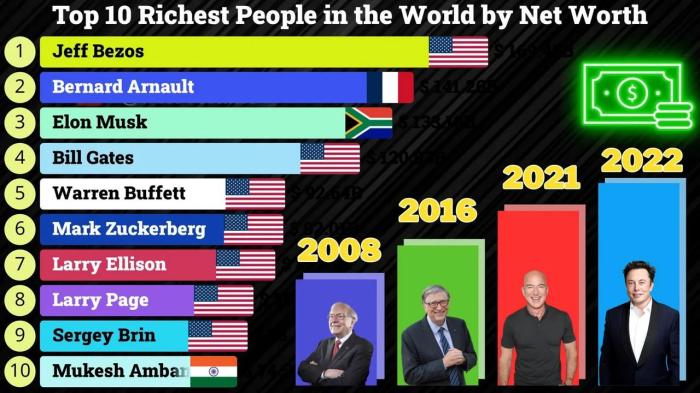
As the world continues to navigate the complexities of technological advancements, one thing is clear: innovation has become a driving force behind the creation of new industries and the subsequent increase in billionaire net worth. The likes of Jeff Bezos, Mark Zuckerberg, and Elon Musk have harnessed the power of technology to revolutionize their respective spaces and reap the rewards of their endeavors.From e-commerce and social media to renewable energy and autonomous vehicles, technological advancements have enabled entrepreneurs to tap into emerging trends and capitalize on their potential.
The result has been a surge in billionaire fortunes, with many individuals seeing their net worth skyrocket as a result of their innovative endeavors.
Innovators Who Have Successfully Adapted to Emerging Trends
The following examples illustrate the impact of technological advancements on billionaire net worth and the importance of adapting to emerging trends:
-
Jeff Bezos, founder and executive chair of Amazon, has been at the forefront of e-commerce innovation. With the rise of online shopping, Bezos transformed Amazon into a behemoth of the retail industry, expanding its scope to include cloud computing, artificial intelligence, and more.
“We’ve had three big waves so far: the first wave was the PC era, then the internet era, and now we’re in the mobile era.”
This shift in focus has enabled Amazon to remain competitive in a rapidly evolving market, with Bezos’ net worth increasing exponentially as a result.
-
Elon Musk, CEO of Tesla and SpaceX, has been a pioneer in the electric vehicle and renewable energy sectors. With the launch of the Tesla Model S, Musk introduced the world to a luxury electric vehicle that captured the imagination of consumers and investors alike.
“The best way to predict the future is to invent it.”
Musk’s commitment to innovation has propelled Tesla to become one of the most valuable companies in the world, with his net worth increasing substantially as a result.
-
Mark Zuckerberg, co-founder and CEO of Facebook, has been instrumental in transforming the social media landscape. With the launch of Facebook, Instagram, and WhatsApp, Zuckerberg has created a digital empire that has connected billions of people around the world.
“The biggest risk is not taking any risks.”
Zuckerberg’s ability to adapt to emerging trends has enabled Facebook to stay ahead of the curve, with his net worth growing exponentially as a result.
Global Tax Regimes

The global financial landscape has witnessed a significant shift in recent years, with an increasing number of high-net-worth individuals (HNWIs) and billionaires evading taxes. The issue of tax evasion has been a pressing concern for governments worldwide, with many calling for a more robust and effective tax regime to collect taxes from these affluent individuals. However, the question remains – do global tax regimes provide an adequate framework for collecting taxes from billionaires?The answer is complex, and it varies significantly depending on the country and its tax system.
Developed countries, such as the United States, the United Kingdom, and Switzerland, have relatively strict tax regimes in place to collect taxes from HNWIs. These countries employ a combination of taxation methods, including wealth taxes, capital gains taxes, and inheritance taxes, to ensure that the wealthy contribute their fair share to the economy.On the other hand, developing countries, such as those in Africa and Asia, often have more lenient tax regimes, making it easier for HNWIs to evade taxes.
These countries may also lack the capacity and resources to effectively enforce tax laws, further exacerbating the problem of tax evasion.
Taxation Methods in Developed Countries
Developed countries have a range of taxation methods to collect taxes from HNWIs. Some of the most common methods include:
- Wealth taxes: Wealth taxes are levied on an individual’s net worth, including assets such as property, stocks, and bonds.
- Capital gains taxes: Capital gains taxes are levied on the profit made from the sale of assets, such as stocks, bonds, and real estate.
- Trusts and foundations: Trusts and foundations are often used by HNWIs to avoid paying taxes on their wealth. However, many developed countries have laws in place to prevent the abuse of these tax avoidance mechanisms.
- Inheritance taxes: Inheritance taxes are levied on the transfer of wealth from one generation to the next.
Taxation Methods in Developing Countries
Developing countries often lack the resources and capacity to effectively enforce tax laws, making it easier for HNWIs to evade taxes. Some of the most common methods include:
- Low tax rates: Developing countries often have low tax rates, making it less expensive for HNWIs to operate in these countries.
- Lack of registration requirements: In many developing countries, there are no requirements for individuals to register their assets or report their income, making it easier to hide wealth.
- Inadequate tax enforcement: Developing countries often lack the resources and capacity to effectively enforce tax laws, making it easier for HNWIs to evade taxes.
- Corruption: Corruption is a significant problem in many developing countries, with officials often turning a blind eye to tax evasion in exchange for bribes or other forms of payment.
Notable Tax Evasion Cases Involving Billionaires
Here are some notable tax evasion cases involving billionaires:
| Name | Country | Tax Evasion Amount | Outcome |
|---|---|---|---|
| Ivor Ichikowitz | South Africa | $2.8 billion | Settled with the South African Revenue Service for $1.1 billion |
| Donald Trump | United States | $400 million | |
| Martin Sorrell | United Kingdom | £10 million | Fined £10.25 million by HMRC for tax evasion |
Conclusion of the Issue
In conclusion, the issue of tax evasion involving billionaires is a complex one, with different countries having varying levels of tax regimes in place. While developed countries have more robust tax laws and enforcement mechanisms, developing countries often lack the resources and capacity to effectively enforce tax laws, making it easier for HNWIs to evade taxes. The examples of notable tax evasion cases involving billionaires demonstrate the scope of the problem and the need for more effective tax laws and enforcement mechanisms to prevent tax evasion.
Regulatory Frameworks: Governing the Wealth Gap
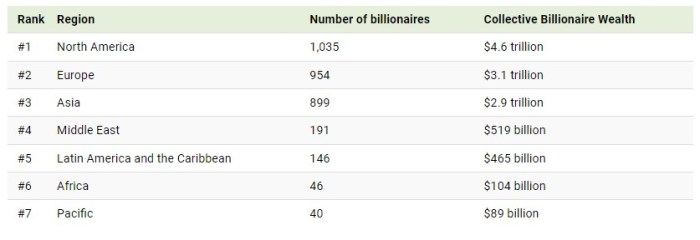
Regulatory frameworks play a crucial role in shaping the global economy and addressing wealth inequality. Governments worldwide have implemented various policies aimed at preventing wealth consolidation and promoting economic growth. In this discussion, we’ll delve into the effectiveness of these regulations and compare policies implemented in different countries.
Types of Regulatory Frameworks
Regulatory frameworks can be categorized into tax policies, financial regulations, and social welfare initiatives. These frameworks aim to prevent wealth consolidation by taxing excessive wealth, regulating financial institutions, and providing social safety nets for vulnerable populations.
Tax Policies
Tax policies are a key component of regulatory frameworks, as they directly influence the distribution of wealth. Some countries have implemented wealth taxes, such as the wealth tax in Spain, which taxes net assets above €3 million at a rate of 0.2%. Other countries, like the United States, have a more complex tax system, with no federal wealth tax but multiple state-level inheritance taxes.
Despite these efforts, tax evasion and avoidance remain significant concerns. A 2020 report by the Tax Justice Network estimated that global tax evasion amounts to $427 billion annually. This highlights the need for more effective tax policies and international cooperation to combat tax evasion.
- Wealth tax (e.g., Spain, Sweden)
- Inheritance tax (e.g., United States, United Kingdom)
- Capital gains tax (e.g., United States, Canada)
Financial Regulations
Financial regulations aim to prevent excessive speculation and ensure the stability of financial markets. The Dodd-Frank Act in the United States, for example, regulates banks and other financial institutions to prevent another financial crisis.
Financial regulations can also promote economic growth by encouraging investment in productive sectors. A study by the International Monetary Fund found that financial regulations can increase economic growth by 1.4% annually in countries with weak financial systems.
- Bank regulation (e.g., Dodd-Frank Act in the United States)
- Capital requirements for banks and financial institutions (e.g., Basel Accord)
- Anti-money laundering regulations (e.g., Financial Action Task Force)
Social Welfare Initiatives, Total net worth of all billionaires
Social welfare initiatives aim to provide support for vulnerable populations and promote economic mobility. Programs like the Earned Income Tax Credit (EITC) in the United States and the minimum wage in Germany provide a safety net for low-income individuals.
Social welfare initiatives can also reduce wealth inequality by promoting education and job training. A study by the World Bank found that education and job training programs can increase lifetime earnings by 10-20% for individuals from low-income backgrounds.
- Earned Income Tax Credit (EITC) in the United States
- Minimum wage (e.g., Germany, Australia)
- Education and job training programs (e.g., World Bank’s Skills for Employability and Productivity program)
Conclusion
Regulatory frameworks play a critical role in addressing wealth inequality and promoting economic growth. By understanding the types of regulatory frameworks and comparing policies across countries, we can identify effective approaches to governing the wealth gap. The success of regulatory frameworks ultimately depends on their effectiveness in preventing wealth consolidation, promoting economic growth, and providing social welfare support for vulnerable populations.
Top FAQs: Total Net Worth Of All Billionaires
Q: How does the total net worth of all billionaires impact the global economy?
A: The total net worth of all billionaires can have either positive or negative impacts on the global economy, depending on how it is distributed and utilized. A small percentage of individuals holding a large percentage of wealth can lead to increased economic growth and job creation, but it can also result in further economic inequality and social unrest if not managed properly.
Q: What role does philanthropy play in reducing wealth disparities?
A: Philanthropy can play a significant role in reducing wealth disparities by giving back to the community and improving the lives of those in need. Billionaires who engage in philanthropy can help bridge the gap between the haves and have-nots and promote a more equitable distribution of wealth.
Q: Can governments effectively regulate the accumulation of wealth to promote economic growth?
A: Governments can implement policies aimed at preventing wealth consolidation and promoting economic growth, such as progressive taxation, financial regulations, and education and job creation programs. However, the effectiveness of these policies depends on various factors, including the implementation process and the level of commitment.
Q: How does technological advancement impact the creation of new industries and the increase in billionaire net worth?
A: Technological advancements can lead to the creation of new industries and increase in billionaire net worth by providing opportunities for entrepreneurs and investors to capitalize on emerging trends and innovation. Examples include the rise of the internet, social media, and renewable energy.
