Net worth of all people in the world paints a complex picture where individual fortunes are intertwined with global economic stability. The notion of economic prosperity is not just about individual success, but also about collective wealth and how it’s distributed among different populations.
This story is a journey across the globe, delving into the intricacies of global wealth trends, factors that influence net worth, and the impact of economic systems, cultural differences, and historical events on individual and collective prosperity.
The Concept of Net Worth and its Significance in Global Economy

Net worth is a critical metric that provides a snapshot of an individual or a country’s financial health. It represents the total value of their assets minus their liabilities, reflecting their net economic position. In the global economy, net worth holds significant importance as it serves as a gauge of economic stability, influencing investment decisions, credit ratings, and even international trade agreements.The importance of net worth in assessing economic stability across the globe lies in its ability to account for both assets and liabilities.
Countries with high net worth are generally characterized by robust economies, with a higher capacity to absorb economic shocks and invest in strategic sectors. Conversely, nations struggling with low net worth often face difficulties in servicing debt, making it challenging to invest in critical areas such as education, healthcare, and infrastructure.
Influence of Income Inequality and Economic Growth on Net Worth
Income inequality and economic growth are two key factors that can significantly impact a country’s net worth. Income inequality, in particular, can lead to reduced economic mobility, decreased consumer spending, and ultimately, lower net worth. On the other hand, sustained economic growth often translates to increased investment, higher economic output, and, consequently, higher net worth.
Real-World Examples of Countries with High Net Worth
Several countries are known for their high net worth, reflecting their robust economies and strategic investments. Switzerland, for instance, boasts a net worth of over $70 trillion, largely due to its stable banking system, high-tech industries, and significant foreign exchange reserves. Similarly, countries like Norway and Singapore have high net worth, driven by their strong oil and gas sectors, as well as innovative industries such as biotechnology and finance.
Challenges Facing Countries with Low Net Worth
Countries struggling with low net worth often face significant economic challenges. Greece, for example, has struggled with a substantial debt burden, leading to reduced investment in critical sectors and decreased economic competitiveness. Similarly, countries like Venezuela and Argentina have faced significant economic difficulties due to years of mismanagement, corruption, and reliance on extractive industries.
Net worth can be calculated using the following formula: Net Worth = Assets – Liabilities.
In conclusion, net worth is a critical metric that plays a significant role in assessing economic stability across the globe. Understanding the factors that influence net worth, such as income inequality and economic growth, can provide valuable insights into a country’s financial health. By examining real-world examples of countries with high and low net worth, we can gain a deeper appreciation for the complexities of the global economy and the importance of prudent economic management.
- Switzerland: Net worth over $70 trillion, driven by stable banking system, high-tech industries, and significant foreign exchange reserves.
- Norway: Net worth over $50 trillion, fueled by strong oil and gas sectors, as well as innovative industries like biotechnology and finance.
- Singapore: Net worth over $40 trillion, driven by robust finance sector, trade-friendly policies, and strategic investments in education and infrastructure.
| Country | Net Worth (trillion USD) | Main Drivers |
|---|---|---|
| Switzerland | 70+ | Stable banking system, high-tech industries, foreign exchange reserves |
| Norway | 50+ | Oil and gas sectors, biotechnology, finance |
| Singapore | 40+ | Finance sector, trade-friendly policies, education, infrastructure |
Measuring and Estimating Net Worth in Emerging Markets
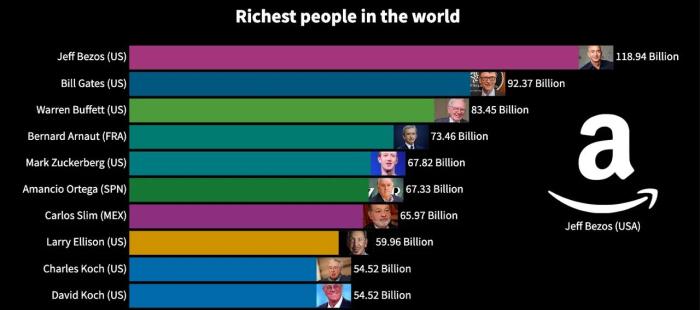
In the pursuit of a more inclusive and robust global economy, estimating net worth in emerging markets has become a pressing concern. The challenge lies in navigating limited data and infrastructure, as these regions struggle to provide comprehensive financial assessments.Measuring net worth in emerging markets presents a multitude of challenges due to the scarcity of reliable data, outdated infrastructure, and lack of transparency.
For instance, in many developing countries, financial institutions often rely on rudimentary accounting methods, which lead to inaccurate and incomplete financial records. This, in turn, hampers the ability to accurately estimate net worth, a crucial metric for gauging economic stability and growth.
Methods for Estimating Net Worth in Emerging Markets, Net worth of all people in the world
A variety of methods have been employed to estimate net worth in emerging markets, albeit with varying degrees of success. These include:Estimating net worth through secondary data sources: Researchers have relied on secondary data sources such as government statistics, World Bank reports, and other reputable institutions to estimate net worth. However, this approach often relies on outdated information and may not capture the nuances of the local economy.Using econometric models: Econometric models have been deployed to estimate net worth based on historical data, macroeconomic indicators, and other relevant factors.
While these models provide a relatively reliable estimate, their accuracy depends heavily on the quality of the data used.Incorporating qualitative assessments: In regions with insufficient quantitative data, researchers have turned to qualitative assessments, such as conducting surveys, interviewing local business owners, and gathering anecdotal evidence. While these methods provide valuable insights, they often lack the rigor of quantitative analysis.
Potential Biases in Estimating Net Worth in Emerging Markets
Several biases can influence the accuracy of net worth estimates in emerging markets:Measurement error: Inadequate data collection and outdated accounting methods can lead to inaccuracies in net worth estimates.Sampling bias: Sampling frames may not be representative of the overall population, resulting in biased estimates.Non-response bias: Respondents may refuse to participate in surveys or surveys may not reach their intended audience, compromising the accuracy of qualitative assessments.
Solutions for Improving Net Worth Measurement in Emerging Markets
To mitigate the challenges associated with measuring net worth in emerging markets, several solutions can be implemented:Investing in infrastructure: Governments and international organizations can invest in upgrading financial infrastructure, including modernizing accounting systems and digitizing financial records.Improving data collection: Efforts can be made to collect more comprehensive and accurate data through surveys, interviews, and other means.Developing econometric models: Researchers can develop more sophisticated econometric models that account for regional-specific factors and nuances.Promoting transparency and accountability: Encouraging transparency and accountability in financial practices can help build trust and improve the accuracy of net worth estimates.Developing more robust sampling frames: Researchers can create more inclusive sampling frames that capture the diversity of the local population.Fostering partnerships: Collaborations between researchers, governments, and international organizations can help develop more comprehensive and accurate net worth estimates.
The relationship between net worth and environmental sustainability

As the world’s population continues to grow, so does the pressure on the planet’s resources. Climate change, pollution, and environmental degradation are just a few of the many consequences of human activities. The relationship between net worth and environmental sustainability is complex and multifaceted, with both direct and indirect links. In this section, we will explore how net worth can be influenced by environmental degradation and sustainability practices, and discuss examples of companies and governments that have successfully integrated sustainability into their net worth calculations.
Environmental Degradation and Net Worth
Environmental degradation can have a significant impact on economic outcomes, including net worth. The loss of natural resources, decreased biodiversity, and damage to ecosystems can all contribute to reduced economic activity, decreased productivity, and lower net worth. For example, a study by the World Bank found that every dollar invested in environmental protection returns up to $4 in economic benefits.
This includes cost savings, increased revenue, and improved quality of life.
-
A key factor in environmental degradation is the loss of natural resources, such as deforestation and water pollution. These activities can lead to decreased economic activity, as forests and waterways are essential for industries such as agriculture, forestry, and tourism. In contrast, companies that prioritize sustainability, such as Patagonia, have seen significant economic benefits from preserving natural resources and reducing waste.
-
Decreased biodiversity can also have a negative impact on economic outcomes. As ecosystems become less resilient, they are more vulnerable to disruption, which can result in significant economic losses. For example, a study by the Intergovernmental Science-Policy Platform on Biodiversity and Ecosystem Services (IPBES) found that up to 75% of the world’s ecosystem services are being degraded or used unsustainably.
-
The impact of environmental degradation on net worth can be significant. A study by the World Economic Forum found that the global economy could lose up to $5 trillion in economic output by 2050 due to climate change and environmental degradation.
Implementing Sustainability into Net Worth Calculations
Some companies and governments are recognizing the importance of environmental sustainability in their net worth calculations. By integrating sustainability into their financial reporting, they can better understand the impact of their activities on the environment and make more informed decisions to reduce their ecological footprint.
“At Patagonia, we’ve long believed that environmental sustainability and financial stewardship are deeply intertwined. By prioritizing sustainability, we’re able to reduce costs, increase revenue, and improve our brand reputation.”
Rose Marcario, former CEO of Patagonia
-
The World Wildlife Fund (WWF) has developed a set of guidelines for companies to report on their sustainability performance. These guidelines include metrics such as greenhouse gas emissions, water usage, and waste reduction. By following these guidelines, companies can create a more comprehensive picture of their environmental impact and make more informed decisions.
-
The European Union (EU) has implemented the Non-Financial Reporting Directive (NFRD), which requires large companies to disclose their environmental and social impact. This includes metrics such as greenhouse gas emissions, water usage, and labor standards. By requiring companies to disclose their sustainability performance, the EU is promoting transparency and accountability.
Policies and Regulations
Governments and regulatory bodies are beginning to recognize the importance of environmental sustainability in net worth calculations. Policies and regulations are being implemented to promote environmentally responsible net worth management.
-
The Green Climate Fund (GCF) provides funding for countries to develop and implement environmentally sustainable infrastructure projects. By prioritizing sustainability, countries can reduce their ecological footprint and attract investors who share their values.
-
The EU’s EU Emissions Trading System (EU ETS) is a cap-and-trade system for greenhouse gas emissions. By putting a price on carbon emissions, the EU ETS creates a financial incentive for companies to reduce their emissions and invest in sustainable technologies.
“The connection between economic development and environmental sustainability is clear. By prioritizing sustainability, we can create a more prosperous and resilient future for all.”
Greta Thunberg
The Impact of Technology on Net Worth Dynamics

The world is witnessing a technological revolution that’s transforming the way people create, manage, and grow their net worth. Digital technologies like cryptocurrencies, online financial platforms, and mobile payments are increasingly becoming an integral part of our daily lives. These advancements have opened up new avenues for individuals to invest, earn, and accumulate wealth, but they’ve also introduced unprecedented risks and challenges.
As we navigate this digital landscape, it’s essential to understand the implications of these technological shifts on global net worth dynamics.
Emergence of Cryptocurrencies and Decentralized Finance
The rise of cryptocurrencies, such as Bitcoin and Ethereum, has redefined the concept of money and ownership. Blockchain technology, the underlying infrastructure of cryptocurrencies, enables secure, transparent, and decentralized transactions. This has led to the creation of new financial instruments, like stablecoins and decentralized finance (DeFi) protocols, which are revolutionizing the way people borrow, lend, and invest money. With the growth of cryptocurrencies, traditional financial systems are facing intense competition, and traditional financial institutions are being forced to adapt to the changing landscape.
Benefits of Digital Technologies for Net Worth Holders
Digital technologies have democratized access to finance, enabling individuals to participate in the global economy like never before. Some of the key benefits for net worth holders include:
- Increased liquidity: Digital platforms have made it easier for individuals to buy, sell, and exchange assets quickly and efficiently, reducing the need for intermediaries and lowering transaction costs.
- Diversification opportunities: Cryptocurrencies and other digital assets have expanded portfolio diversification options, allowing individuals to hedge against inflation, market volatility, and currency fluctuations.
- Accessibility: Digital technologies have bridged geographical and socioeconomic divides, enabling people in emerging markets to access financial services and participate in global trade.
- Transparency: Blockchain technology ensures that all transactions are recorded and verified, reducing the risk of fraud and increasing trust in financial systems.
The increasing use of mobile payments and digital wallets has also reduced the need for physical cash, enabling people to store and transfer money safely and securely.
Risks and Challenges Associated with Digital Technologies
While digital technologies have opened up new opportunities, they also introduce significant risks and challenges for net worth holders:
- Volatility: Cryptocurrency markets are notorious for their volatility, making it difficult for investors to predict price movements and manage risk.
- Regulatory uncertainty: The lack of clear regulations and standards for digital assets has created uncertainty and volatility in the market.
- Security risks: The increasing use of digital platforms has also created new security risks, including hacking, phishing, and identity theft.
- Market manipulation: The opacity of digital markets has raised concerns about market manipulation and insider trading.
To mitigate these risks, regulators and financial institutions must work together to establish clear guidelines and regulations for digital assets and technologies.
Potential Regulatory Challenges and Opportunities for Innovation
The regulatory landscape for digital technologies is complex and evolving. As digital assets and platforms continue to grow in popularity, regulators must strike a balance between promoting innovation and ensuring investor protection.
| Regulatory Challenges | Opportunities for Innovation |
|---|---|
|
|
By understanding the impact of digital technologies on net worth dynamics, we can better navigate the changing landscape of finance and build more resilient and prosperous financial systems for all.
(End)

Questions and Answers: Net Worth Of All People In The World
What is the average global net worth per capita?
The average global net worth per capita is difficult to determine due to varying factors like income inequality and differences in economic systems. However, estimates suggest that it ranges from $1,700 to $3,000.
Are there any examples of countries with high net worth growth rates?
Countries like Singapore, Switzerland, and Norway have consistently demonstrated high net worth growth rates due to strong economic policies, favorable business environments, and investments in sustainability practices.
Can environmental sustainability influence net worth?
Yes, environmental sustainability can significantly impact net worth by reducing the risk of losses associated with natural disasters, promoting the adoption of eco-friendly technologies, and enhancing a company’s reputation and brand value.
What role does technology play in shaping net worth dynamics?
Technology has dramatically altered net worth dynamics, enabling global transactions, promoting access to financial services, and empowering individuals with digital literacy and financial skills.
