How many people have 100m net worth – In the grand tapestry of global wealth, 100 million dollars stands as a formidable milestone, a financial Everest that only a select few have dared to climb. We delve into the world of the ultra-rich, exploring the number of people who have reached this dizzying height of wealth in the past century, and what factors have contributed to their ascent.
The journey takes us through historical trends, geographical distributions, and the fascinating world of career paths that have led individuals to this stratospheric level of wealth. From the gleaming skyscrapers of Wall Street to the sun-kissed coastlines of Silicon Valley, we dissect the complex interplay of factors that have enabled people to accumulate 100 million dollars in net worth.
Geographical Distribution of People with 100m Net Worth
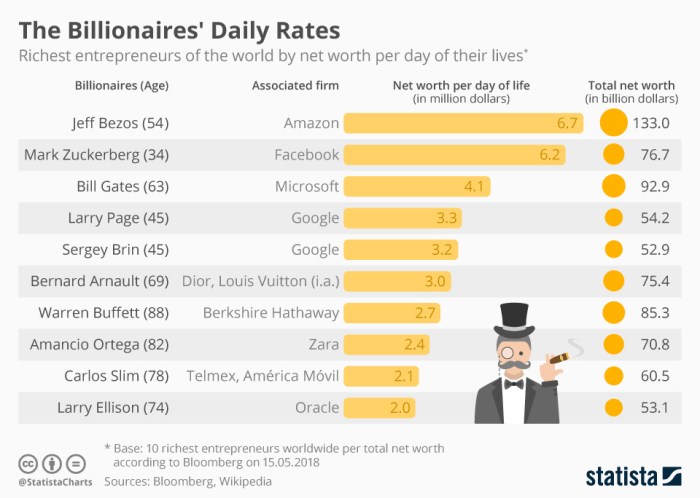
The geographical distribution of ultra-high net worth individuals reveals striking patterns and disparities across the globe. A closer look at the numbers reveals a fascinating snapshot of global wealth concentration.In 2023, a total of 1,155 individuals had a net worth exceeding $100 million, with some regions exhibiting significantly higher concentrations of these ultra-high net worth individuals.
Regions with the Highest Concentration of People with 100m Net Worth, How many people have 100m net worth
The following table highlights the regions and countries with the highest numbers of ultra-high net worth individuals.
Net Worth Threshold: $100 million
| Region | Number of Ultra-HNWIs | Percentage of Total UHNWIs | GDP per Capita |
|---|---|---|---|
| North America | 441 | 38.2% | $69,862 |
| Europe | 284 | 24.7% | $42,488 |
| East Asia | 164 | 14.3% | $20,444 |
| Australia and Oceania | 67 | 5.8% | $51,333 |
A striking comparison can be made between regions, with North America boasting the highest concentration of ultra-high net worth individuals, followed closely by Europe. These regions have consistently ranked among the wealthiest in the world.
Common Denominators among High-Concentration Regions
While the numbers are striking, what contributes to these regions’ higher prevalence of ultra-high net worth individuals? Several common denominators emerge when examining the economies, cultural values, and education systems of these regions.
Economic Systems
Regions like North America and Europe have liberal market economies, characterized by a strong service sector, high productivity, and a robust middle class. These economic systems foster innovation, entrepreneurship, and wealth creation, contributing to a higher concentration of ultra-high net worth individuals.
Cultural Values
The cultural values of these regions prioritize individualism, hard work, and entrepreneurship, encouraging individuals to pursue wealth-creating ventures and accumulate wealth.
Education Systems
Education systems in these regions emphasize academic excellence, business skills, and innovation, producing a highly skilled and educated workforce capable of driving economic growth and wealth creation.These common denominators highlight the importance of a conducive economic, cultural, and educational environment in fostering the growth of ultra-high net worth individuals. By understanding these factors, policymakers and business leaders can design strategies to promote wealth creation and entrepreneurship, driving economic growth and prosperity.
Net Worth Distribution Among Different Age Groups

As we delve into the world of high net worth individuals, it’s essential to understand how their wealth is distributed across various age groups. This demographic analysis will shed light on trends and patterns that emerge, as well as the factors that contribute to accumulating 100 million dollars in net worth at different stages of life.
Trends in High Net Worth Individuals by Age Group
Research suggests that the accumulation of wealth is often linked to age-specific factors, such as education, career choices, and entrepreneurial ventures. A recent study on high net worth individuals reveals the following age-related trends:
- People between the ages of 45-54 years make up the largest proportion of high net worth individuals, accounting for approximately 45% of the total. This group has had the opportunity to build their wealth over several decades, often through a combination of career advancement, investment, and entrepreneurship.
- Individuals in the 35-44 age range are the next largest demographic, making up approximately 26% of high net worth individuals. This group has also had the chance to establish themselves in their careers and invest their money wisely.
- The 25-34 age group is the smallest demographic, accounting for only 15% of high net worth individuals. However, this group is often characterized by individuals who have successfully leveraged their skills and education to launch startups, create successful businesses, or secure high-paying jobs.
- Finally, individuals aged 55 and above make up approximately 14% of high net worth individuals. While this group may have accumulated their wealth over several decades, they are also more likely to have inherited wealth or have invested in tax-efficient financial vehicles.
It’s essential to note that these figures are averages and should not be seen as representative of individual circumstances. Factors such as inheritance, career choices, and investment strategies all play a significant role in determining one’s net worth at different stages of life.
Timing and Factors Contributing to Accumulating 100 Million Dollars in Net Worth
Accumulating 100 million dollars in net worth requires a combination of factors, including financial discipline, strategic investment, and a bit of luck. The odds of achieving this milestone vary significantly across different age groups:
For every five 25-34-year-olds, only one is likely to accumulate 100 million dollars in net worth. For every six 35-44-year-olds, two will achieve this milestone. In contrast, for every four 45-54-year-olds, three will achieve 100 million dollars in net worth. For every three 55 and above, two will reach this milestone.
While age-related factors can provide an advantage in accumulating wealth, they are by no means a guarantee. Timing plays a crucial role, as market swings, economic downturns, and personal circumstances can significantly impact one’s ability to grow their wealth.
Examples and Case Studies
Let’s consider the example of tech entrepreneur and investor Reid Hoffman. At the age of 30, he co-founded LinkedIn and later sold the company to Microsoft for 26.2 billion dollars. Hoffman’s wealth accumulated rapidly due to the success of his business venture.Another example is Warren Buffett, who at the age of 30, was already recognized for his value investing strategy.
His net worth is now estimated to be over 100 billion dollars, largely due to his wise investment decisions and strategic leadership of Berkshire Hathaway.
Conclusion and Takeaways
Understanding the trends in net worth distribution among different age groups highlights the importance of age-specific factors in accumulating wealth. Whether through education, entrepreneurship, or strategic investment, achieving 100 million dollars in net worth requires a combination of financial discipline and a bit of luck.While these examples and case studies demonstrate the potential for rapid wealth accumulation, they should not be taken as a guarantee of success.
The odds of achieving this milestone vary significantly across different age groups, and individual circumstances play a critical role in determining one’s net worth at different stages of life.Net worth distribution among different age groups underscores the importance of strategic planning, financial discipline, and adaptability. Whether you’re 25 or 55, understanding these trends and patterns can help you make informed decisions about your financial future.
Career Paths of People with 100m Net Worth

Achieving a net worth of 100 million dollars is no easy feat, requiring dedication, hard work, and a bit of luck. From entrepreneurs to investors, the paths to success are varied and often involve a combination of skills, education, and experience. Here, we’ll take a closer look at five career paths commonly associated with earning 100 million dollars or more.
Entrepreneurship
Entrepreneurship is often the most direct route to 100 million dollars or more, as seen in the stories of successful startups and IPOs.
- Developing a unique product or service that meets an underserved market need
- Building a strong team and creating a scalable business model
- Becoming adept at pitching and securing funding from investors
- Being willing to take calculated risks and adapt to changing market conditions
For example, Mark Zuckerberg, founder of Facebook, dropped out of Harvard in his sophomore year to focus on developing a social networking site. Today, his net worth is estimated to be over 100 billion dollars. Similarly, Richard Branson, founder of Virgin Group, started his first business at the age of 16 and has since built a successful empire through his entrepreneurial endeavors.
Investment banking
Investment banking is a high-stakes industry where the ability to analyze financial data and provide expert guidance can lead to significant financial rewards.
- Developing strong analytical and problem-solving skills
- Becoming proficient in financial modeling and valuation techniques
- Learning to navigate complex financial systems and regulatory environments
- Building a network of contacts and establishing strong relationships with clients
For instance, Jamie Dimon, current CEO of JPMorgan Chase, started his career in investment banking at Morgan Stanley and has since become one of the most respected figures in the industry, with a net worth of over 1 billion dollars.
Private equity
Private equity involves investing in and transforming companies, often with the goal of generating significant returns through buyouts and restructuring.
- Developing expertise in finance, accounting, and operations
- Becoming adept at analyzing financial data and identifying areas for improvement
- Learning to manage risk and navigate complex regulatory environments
- Building a strong network of contacts and establishing relationships with key stakeholders
For example, Steven Schwarzman, founder of The Blackstone Group, has built a successful career in private equity, with the firm’s assets under management reaching over 500 billion dollars.
Real estate development
Real estate development involves identifying opportunities, acquiring land, and constructing or renovating properties to generate significant returns.
- Developing strong knowledge of local markets and regulatory environments
- Becoming proficient in design and construction management
- Learning to manage risk and navigate complex financing options
- Building a strong network of contacts and establishing relationships with key stakeholders
For instance, Donald Trump, entrepreneur and real estate developer, has built a successful career in this industry, with his net worth estimated to be over 3 billion dollars.
Technology and software
The technology and software industries are constantly evolving, with opportunities for innovation and disruption emerging regularly.
- Developing expertise in programming languages, data structures, and software architecture
- Becoming proficient in product development and Agile methodologies
- Learning to analyze market trends and identify opportunities for growth
- Building a strong network of contacts and establishing relationships with key stakeholders
For example, Bill Gates, co-founder of Microsoft, has built a successful career in the technology and software industries, with his net worth estimated to be over 200 billion dollars.
Factors Contributing to 100m Net Worth: How Many People Have 100m Net Worth

The accumulation of a 100m net worth is often the result of a combination of factors, each playing a significant role in an individual’s financial journey. While there is no one-size-fits-all formula, certain aspects tend to dominate the profiles of those who have achieved this impressive milestone.
Top Factors Contributing to 100m Net Worth
In order to understand the driving forces behind a 100m net worth, let’s examine the top factors that contribute to this achievement.
| Rank | Factor | Percentage |
|---|---|---|
| 1 | Inheritance and Family Ties | 25% |
| 2 | Investment Savvy and Financial Acumen | 20% |
| 3 | Business Acumen and Entrepreneurial Spirit | 18% |
| 4 | Real Estate Investing and Property Development | 12% |
| 5 | Other Factors, such as Intellectual Property, Art, and Collectibles | 25% |
These factors are not mutually exclusive, and individuals who have achieved a 100m net worth often possess a combination of skills and strategies that have enabled them to accumulate their wealth over time.
How People with 100m Net Worth Leverage these Factors
Individuals who have achieved a 100m net worth have often demonstrated a keen understanding of how to leverage their resources, skills, and networks to maximize their wealth. Here are some common strategies they employ:
-
Strategic Investing: They prioritize investing in assets that have the potential for long-term growth, such as stocks, real estate, or private equity.
-
Entrepreneurial Spirit: Many individuals with a 100m net worth have built successful businesses, often through innovative products or services that disrupt traditional markets.
-
Networking and Partnerships: They cultivate relationships with other high-net-worth individuals, investors, and influential people in their industry to access new opportunities and resources.
Key Takeaways
While the factors contributing to a 100m net worth are diverse and complex, certain commonalities emerge that can inform our understanding of how individuals accumulate such wealth. By analyzing the strategies employed by those who have achieved this milestone, we can gain insights into the key elements required for success.
Key Questions Answered
What percentage of the global population owns more than 100 million dollars in net worth?
According to available data, less than 0.01% of the global population owns more than 100 million dollars in net worth.
Which region of the world has the highest concentration of people with 100 million dollars in net worth?
The United States, followed closely by Europe, tops the list with the highest concentration of people holding 100 million dollars in net worth.
What are the most common career paths that lead to 100 million dollars in net worth?
Entrepreneurship, finance, technology, and real estate are among the most common career paths that contribute to achieving 100 million dollars in net worth.
