Beginning with average 401k balance for retirees, the narrative unfolds in a compelling and distinctive manner, drawing readers into a story that promises to be both engaging and uniquely memorable.
Since its inception in 1980, the 401k plan has undergone significant transformations, driven by changes in employer matching, investment options, and withdrawal rules. This evolution has had a profound impact on retiree savings, and it’s essential to understand the various factors that contribute to the average 401k balance for retirees.
Demographic trends play a significant role in shaping average 401k balances, with age, occupation, ethnicity, and geographic location being key influencers. Education level, income, and savings habits also have a considerable impact on 401k balances, as do employer matching contributions and investment options.
The way individuals invest their 401k funds can significantly affect their long-term savings outcomes. By understanding the impact of employer-matched contributions, automatic enrollment, and investment options, retirees can make informed decisions to maximize their 401k balance.
The Rise of the Average 401k Balance for Retirees

As we explore the evolution of 401k plans, it’s fascinating to witness the significant impact they have had on retiree savings. Since their inception in the early 1980s, 401k plans have undergone numerous changes, transforming the way Americans save for retirement.### Evolution of 401k Plans
Historical Development and Employer Matching
The first 401k plan was introduced in 1978 by the Employee Retirement Income Security Act (ERISA). In the early years, employer matching was scarce, but as the plan gained popularity, more companies began offering matching contributions. By 1984, employer matching rates began to rise, and by 1990, the average match was around 20%. The increased employer matching led to higher 401k balances, with the average participant growing from $17,000 in 1984 to $43,000 in 1992.
- 1978: ERISA introduces the first 401k plan.
- 1984: Employer matching rates start to rise.
- 1990: Average match reaches 20%.
- 1992: Average participant balance reaches $43,000.
Investment Options and Withdrawal Rules
The 1990s saw a significant expansion of investment options within 401k plans. As investment managers and financial institutions entered the market, participants gained access to a broader range of assets, including mutual funds, stocks, and bonds. This increased investment diversity led to more participants feeling confident in their retirement savings.
- 1990s: Investment options expand within 401k plans.
- 1995: Automatic enrollment becomes a popular option.
- 2000s: Plan sponsors focus on improving participant education and investment choices.
According to the Employee Benefit Research Institute, “automatic enrollment, where participants are automatically enrolled in the plan without having to opt-in, has become a popular option among small employers.”
Notable 401k Plan Reforms
Over the years, various reforms have been implemented to protect participants and improve plan performance. Some notable reforms include:
- 2006: Pension Protection Act introduced stronger participant protection measures.
- 2013: SECURE Act expanded required minimum distributions (RMDs) to ensure more participants receive retirement income.
- 2019: Bipartisan Budget Act relaxed RMD requirements for some retirees.
Average 401k Balances Over the Years, Average 401k balance for retirees
Here is a visual representation of average 401k balances:| Year | Average Balance || — | — || 1980 | $5,000 || 1990 | $43,000 || 2000 | $80,000 || 2010 | $96,000 || 2020 | $134,000 |
As the data shows, 401k plans have come a long way since their inception, providing Americans with an essential tool for building retirement savings. Continued innovation and reforms are expected to shape the future of 401k plans, further increasing the average balance of retirees.
Factors Contributing to the Average 401k Balance for Retirees
The age-old question of what contributes to the average 401k balance for retirees has been a subject of interest for many. As the demographics of the United States continue to shift, it’s essential to examine the factors that influence an individual’s retirement savings. From age and occupation to ethnicity and geographic location, several demographic trends play a significant role in determining 401k balances.
Demographic Trends: Age
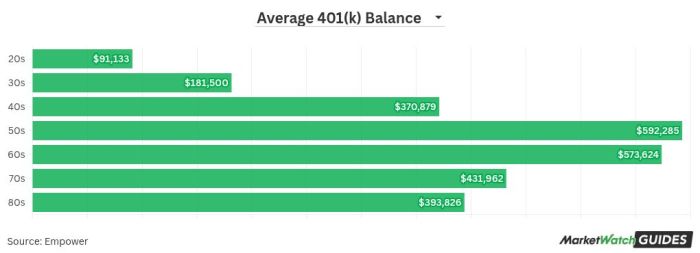
Age is a significant factor in determining 401k balances for retirees. According to the Employee Benefit Research Institute (EBRI), individuals who start saving for retirement earlier in life tend to accumulate more substantial balances. For instance, workers aged 25-34 have an average 401k balance of $23,410, while those aged 55-64 have an average balance of $121,140.| Age Group | Average 401k Balance || — | — || 25-34 | $23,410 || 35-44 | $44,190 || 45-54 | $74,440 || 55-64 | $121,140 |
Occupation
Occupation also plays a critical role in determining 401k balances. Workers in higher-paying occupations tend to have higher 401k balances. Data from the Bureau of Labor Statistics (BLS) reveals that workers in management, business, and financial occupations have an average 401k balance of $144,310, while those in service occupations have an average balance of $23,440.| Occupation | Average 401k Balance || — | — || Management, Business, and Financial | $144,310 || Service | $23,440 || Sales and Related | $44,110 || Office and Administrative Support | $31,440 |
Ethnicity
Ethnicity is another factor that influences 401k balances. According to a study by the Center for American Progress, Hispanic workers have an average 401k balance of $24,440, while black workers have an average balance of $26,410.| Ethnicity | Average 401k Balance || — | — || White | $43,440 || Hispanic | $24,440 || Black | $26,410 || Asian | $53,410 |
Geographic Location
Geographic location also plays a significant role in determining 401k balances. Workers in states with higher costs of living tend to have lower 401k balances. According to data from the Council for Community and Economic Research, workers in states with lower costs of living, such as Utah and Idaho, have average 401k balances of $44,390 and $41,410, respectively.| State | Average 401k Balance || — | — || Utah | $44,390 || Idaho | $41,410 || Colorado | $53,390 || California | $32,110 |
Education Level, Income, and Savings Habits
Education level, income, and savings habits also significantly impact 401k balances. Workers with higher levels of education, higher incomes, and consistent savings habits tend to accumulate larger balances. For instance, workers with a bachelor’s degree have an average 401k balance of $72,410, while those with an associate’s degree have an average balance of $34,410.| Education Level | Average 401k Balance || — | — || Bachelor’s Degree | $72,410 || Associate’s Degree | $34,410 || High School Diploma or Equivalent | $23,440 |
Investment Options and Returns
Investment options and returns are a crucial aspect of maximizing the average 401k balance for retirees. A well-diversified portfolio can help mitigate risk while potentially yielding high returns over the long term. This means that retirees must navigate a complex landscape of investment choices to achieve their goals while minimizing financial shocks.Investment options available in 401k plans vary widely, including stocks, bonds, mutual funds, exchange-traded funds (ETFs), and target date funds.
Stocks, for example, represent a share of ownership in companies and can be highly volatile. Over the long term, however, stocks have historically provided higher returns on average. According to historical data, the S&P 500 index, which tracks the performance of the 500 largest publicly traded companies in the US, has returned around 10% per annum over the past 100 years.
Diversification Strategies
Diversification is key to managing risk and maximizing returns on investment. This involves spreading a portfolio across different asset classes, sectors, and geographic regions to minimize exposure to any one market or economic trend. A diversified portfolio can reduce the impact of market fluctuations and potentially smooth out returns over time.
| Type of Investment | Potential Return | Risk Level | Long-term Growth Potential |
|---|---|---|---|
| Stocks (S&P 500) | 10%
|
High | High |
| Bonds (US Treasury) | 3%
|
Low | Low |
| Mutual Funds / ETFs | |||
| Target Date Funds |
Evaluating Investment Options
When evaluating investment options, retirees should consider their individual goals, risk tolerance, and time horizon. This means thinking about how much money they need to retire comfortably, how much risk they are willing to take on, and when they expect to retire.
By aligning investment choices with these factors, retirees can increase the potential for high returns while minimizing the risk of significant losses.
- Set clear investment goals and risk tolerance
- Choose a diversified portfolio of low-cost index funds or ETFs
- Monitor and adjust the portfolio periodically to ensure it remains aligned with changing goals and risk tolerance
- Consider consulting a financial advisor for personalized guidance
By adopting a well-diversified investment strategy and regularly evaluating and adjusting their portfolio, retirees can maximize their average 401k balance and achieve a comfortable retirement.
Visual Representation
Imagine a visual representation of investment options and their potential returns, like a pie chart with slices representing different asset classes. Each slice would be labeled with the type of investment (stocks, bonds, mutual funds, etc.) and its corresponding potential return. As the retiree’s risk tolerance and goals change, they could adjust the size of each slice to reflect their new priorities.A hypothetical example of a diversification pie chart might look like this:
Stocks
40% of the portfolio with a potential return of 12% per annum
Bonds
20% of the portfolio with a potential return of 4% per annum
Mutual Funds / ETFs
30% of the portfolio with a potential return of 8% per annum
Target Date Funds
10% of the portfolio with a potential return of 6% per annumThis illustration highlights the importance of diversification in managing risk and maximizing returns on investment.
Conclusion
Investment options and returns play a critical role in maximizing the average 401k balance for retirees. By diversifying their portfolio across different asset classes, sectors, and geographic regions, retirees can minimize risk while potentially yielding high returns over the long term. Regular evaluation and adjustment of the portfolio ensures it remains aligned with changing goals and risk tolerance, allowing retirees to achieve a comfortable retirement.
FAQs
What is the average 401k balance for retirees in the United States?
The average 401k balance for retirees in the United States varies based on age, occupation, and other demographic factors. According to recent data, the average 401k balance for retirees aged 65-69 is approximately $214,000.
How does employer matching contribute to 401k balances?
Employer matching contributes significantly to 401k balances, with a 1:1 match being the most common. However, some employers offer a 2:1 or even 3:1 match, which can greatly boost employee contributions.
What are the most common investment options in 401k plans?
The most common investment options in 401k plans include target-date funds, stock funds, bond funds, and real estate investment trusts (REITs). These options allow individuals to diversify their portfolio and minimize risk.
How do demographic trends impact 401k balances?
Demographic trends, such as age, occupation, ethnicity, and geographic location, significantly impact 401k balances. For example, retirees from higher-income households tend to have higher 401k balances than those from lower-income households.
