As the spotlight shines on net worth of everyone in the world, a complex web of finance, economics, and human behavior comes into focus. Like a canvas, the landscape of global wealth is painted with vibrant hues of diversity, inequality, and opportunity, beckoning us to explore the intricate details of the world’s collective net worth. From the soaring heights of billionaires to the humble earnings of the working class, the net worth of everyone in the world is an awe-inspiring narrative that weaves together the threads of economic history, cultural influences, and individual choices.
The concept of net worth is a window into the soul of our economic systems, revealing the intricacies of wealth distribution, income inequality, and financial stability. By examining the evolution of net worth calculation, the relationships between net worth, income, and debt, and the role of education and financial literacy in achieving a higher net worth, we can gain a deeper understanding of the intricate mechanisms that shape our financial lives.
International Comparisons of Net Worth and the Impact of Currency Fluctuations

When evaluating the economic well-being of individuals and nations, accurate comparisons of net worth are essential. However, the complexities of international finance introduce a significant challenge: currency fluctuations. These variations can distort the apparent value of assets and liabilities, leading to misleading conclusions.The fluctuations in currency values can significantly affect the calculation of net worth. When comparing countries with different currencies, we must account for these variations to ensure a fair and accurate comparison.
This is particularly crucial when evaluating the net worth of individuals or nations with significant international investments.To address this issue, economists and financial analysts use various methods to adjust for inflation and currency changes. One common approach is to express net worth in a common unit, such as a currency that is widely traded and stable, like the US dollar.Another strategy is to use a currency-agnostic metric, such as a basket of currencies or a purchasing power parity (PPP) estimate.
These methods aim to provide a more stable and comparable measure of net worth across countries with different currencies.
International Net Worth Comparison and Currency Adjustments
To create a more accurate comparison, some economic indicators, like the World Wealth Report, adjust for inflation and currency changes using a specific method. This approach involves converting the net worth of each country into a common unit, allowing for a more meaningful comparison.For instance, when comparing the net worth of wealthy individuals in the United States and Europe, we might use the following steps:
- Identify the exchange rate between the two currencies at a specific date.
- Apply the exchange rate to convert the net worth of each individual from their respective currencies to a common unit.
- Adjust for inflation by using a suitable index, such as the Consumer Price Index (CPI).
- Analyze the resulting adjusted net worth to highlight differences and similarities between the two groups.
- Use a currency-agnostic metric, like the Big Mac Index or the PPP estimate, to provide a more stable and comparable measure.
The Role of Currency Fluctuations in International Net Worth Comparison
Currency fluctuations can have a profound impact on the apparent value of net worth in international comparisons. For example, a country’s currency may appreciate significantly during a year, causing its net worth to increase artificially. Conversely, a depreciating currency can lead to a decrease in net worth.To understand the significance of currency fluctuations, let’s consider an example. Suppose the Swiss franc strengthens by 10% against the US dollar over a specific period.
This would artificially inflate the net worth of Swiss individuals and corporations with assets denominated in US dollars.
Case Studies and Real-Life Examples
Several case studies and real-life examples illustrate the importance of accounting for currency fluctuations in international net worth comparisons.
- The Swiss National Bank’s efforts to contain the appreciation of the Swiss franc by intervening in currency markets.
- The impact of the European debt crisis on the net worth of European nations, as their currencies depreciated in response to the crisis.
- The effects of currency fluctuations on the global wealth of individuals, such as when the value of foreign assets, like foreign real estate or stocks, is affected by currency changes.
The complexities of international finance and the impact of currency fluctuations necessitate a thoughtful and nuanced approach to net worth comparisons. By using currency-agnostic metrics and adjusting for inflation, we can gain a more accurate understanding of the global distribution of wealth and its dynamics.
“Currency fluctuations can have a profound impact on the apparent value of net worth in international comparisons.”
Net worth comparisons across countries must acknowledge the inherent difficulties caused by currency fluctuations. By understanding the methods used to adjust for these variations, we can ensure that our conclusions are grounded in data and provide a more accurate representation of global economic reality.
“The global distribution of wealth is a complex phenomenon that requires careful consideration of currency fluctuations to provide a meaningful comparison of net worth across countries.”
Net Worth and Income Inequality
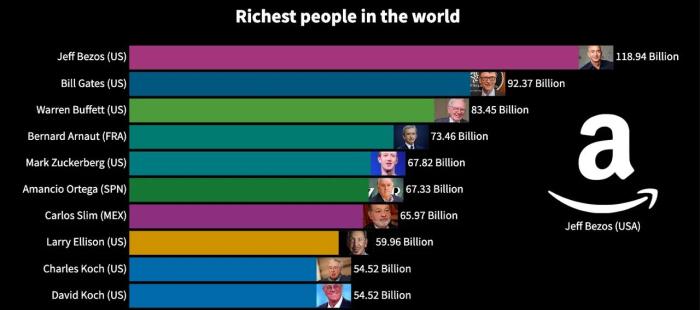
Income inequality and net worth are inextricably linked, with the wealthy holding a disproportionate share of global wealth. This concentration of net worth has far-reaching implications for economic inequality, as it perpetuates a cycle of poverty and inequality. In this section, we’ll delve into the relationship between income inequality and net worth, exploring the data, policy initiatives, and the impact on the global economy.
Concentration of Net Worth
The concentration of net worth among the wealthy is a phenomenon observed globally. According to a report by Oxfam, the world’s richest 1% hold nearly 30% of global assets, while the bottom 90% share a mere 27%. This staggering disparity is a result of the unequal distribution of wealth, with the affluent able to accumulate wealth at an exponential rate through investments, dividends, and other means.As a result, the middle class and low-income earners are left with increasingly limited opportunities to accumulate wealth, perpetuating a cycle of poverty and inequality.
The impact of this concentration of net worth is not limited to individual economic outcomes; it also affects the broader economy, as the wealthy tend to reinvest their wealth, driving economic growth and job creation.Net Worth Distribution:
| Net Worth Distribution | Percentage of Global Wealth |
|---|---|
| Top 1% | 29.7% |
| Top 10% | 76.1% |
| Bottom 90% | 26.9% |
Policy Initiatives
Policy makers have used net worth calculations to inform discussions about income inequality. For instance, the concept of net worth is used to evaluate the effectiveness of wealth transfer policies, such as inheritance taxes and progressive taxation.
- Wealth Transfer Policies:
- Inheritance Tax:
- Progressive Taxation:
- Wealth Redistribution Policies:
- Grants and Subsidies:
- Poverty Alleviation Programs:
Inheritance tax is often levied on the transfer of wealth from one generation to the next. By using net worth calculations, policy makers can determine the impact of inheritance tax on wealth inequality.
Progressive taxation involves taxing the wealthy at a higher rate than the general population. Net worth calculations can help policy makers evaluate the effectiveness of progressive taxation in reducing income inequality.
Wealth redistribution policies, such as grants and subsidies, are often designed to help low-income earners acquire assets and accumulate wealth. Net worth calculations can help policy makers evaluate the effectiveness of these programs.
Poverty alleviation programs aim to reduce poverty by providing support to individuals and families in need. Net worth calculations can help policy makers determine the impact of these programs on wealth inequality.
Global Implications
The concentration of net worth among the wealthy has significant global implications, including:
“The rich are getting richer, while the poor are getting poorer.”
Nobel Laureate Joseph Stiglitz* The perpetuation of poverty and inequality: The concentration of net worth among the wealthy perpetuates a cycle of poverty and inequality, as the wealthy continue to accumulate wealth, while the low-income earners are left with limited opportunities to accumulate wealth.
Economic instability
The concentration of net worth among the wealthy can lead to economic instability, as the wealthy tend to reinvest their wealth, driving economic growth and job creation, but also increasing income inequality.
Social unrest
The concentration of net worth among the wealthy can lead to social unrest, as individuals and groups begin to question the fairness and effectiveness of the economic system.Net worth and income inequality are deeply intertwined, with the wealthy holding a disproportionate share of global wealth. Policy makers have used net worth calculations to inform discussions about income inequality, evaluating the effectiveness of wealth transfer policies and wealth redistribution programs.
However, the global implications of the concentration of net worth among the wealthy are far-reaching, perpetuating poverty and inequality, economic instability, and social unrest.
Case Studies of Individuals and Businesses with High Net Worth: Net Worth Of Everyone In The World

Achieving incredible wealth often requires a combination of hard work, smart decisions, and a bit of luck. Let’s take a closer look at some inspiring examples of individuals and businesses that have built substantial net worth, and explore what we can learn from their experiences.One common characteristic among high-net-worth individuals and businesses is a relentless pursuit of innovation and diversification.
Whether it’s investing in emerging technologies or expanding into new markets, these ambitious players refuse to rest on their laurels. Take, for example, Amazon, the retail giant that began as an online bookstore and has since grown into a global leader in e-commerce, cloud computing, and artificial intelligence.
The Importance of Adaptability
Adaptability is a key trait that has allowed successful individuals and businesses to thrive in an ever-changing world. By being willing to pivot and adjust their strategies as circumstances evolve, they’ve managed to stay ahead of the curve and capitalize on emerging opportunities.
- Bezos’ willingness to experiment with new business models, such as AmazonFresh and Prime Day, has helped the company stay relevant and attract new customers.
- The Walt Disney Company’s innovative approach to storytelling and brand extension has enabled it to remain a beloved and successful entertainment giant for nearly a century.
Strategic Risk-Taking, Net worth of everyone in the world
High-net-worth individuals and businesses often demonstrate a willingness to take calculated risks in pursuit of growth and innovation. By carefully weighing the potential benefits and drawbacks of each venture, they’ve managed to achieve impressive returns on their investments.
| Investment | Outcome | Lessons Learned |
|---|---|---|
| Apple’s acquisition of Beats Electronics | A 50% increase in Apple’s music sales revenue | Diversifying into new markets and expanding into adjacent industries can lead to significant growth and revenue increases. |
| Warren Buffett’s investment in Coca-Cola | A 20% annual return over 40 years | Investing in iconic brands with strong track records and resilient business models can yield impressive returns over the long term. |
Sustainable Business Practices
The most successful high-net-worth individuals and businesses prioritize sustainability and social responsibility, recognizing that long-term success requires a commitment to building positive relationships with stakeholders and the environment./blockquote> “The greatest businesses are ones that benefit society as a whole.”
Jeff Bezos /blockquote>
- Patagonia’s commitment to environmental sustainability has enabled the company to reduce its environmental impact and appeal to customers who share its values.
- The IKEA Group’s focus on affordability and accessibility has made its products more widely available to consumers around the world, contributing to the company’s long-term success and reputation.
FAQ Overview
What is the primary driver of income inequality?
The primary driver of income inequality is the concentration of wealth among the wealthy, which creates a self-reinforcing cycle of economic privilege.
How does education impact net worth?
Education has a profound impact on net worth, as higher education levels are associated with higher earning potential, increased financial literacy, and better wealth management skills.
What are some strategies for maximizing net worth in retirement?
Strategies for maximizing net worth in retirement include investing in a diversified portfolio, generating multiple income streams, and maintaining a long-term perspective.
How does taxation impact net worth?
Taxation can have a significant impact on net worth, as changes in tax policies can affect the amount of wealth that individuals and businesses retain.
