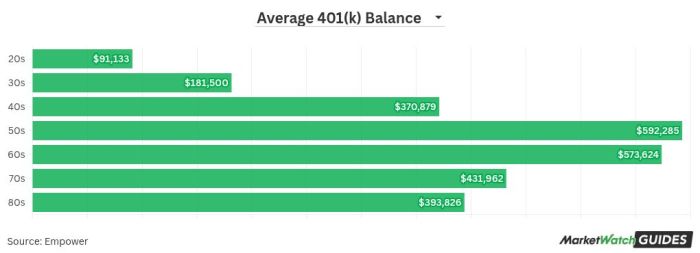
401k recommendations by age – As the sun rises on a new day, a new age beckons, and with it, the importance of securing a 401k for the future takes center stage. For some, the thought of a steady paycheck is just a distant memory, and the pressure to save for retirement seems overwhelming. However, with the right strategy, every milestone age brings new opportunities to optimize your 401k, from early twenties to beyond fifty.
In this comprehensive guide, we’ll explore the essential recommendations for 401k savings by age, providing a clear roadmap for achieving a secure financial future.
From the optimal asset allocation for a 20-30 age group, navigating 401k plan options, to maximizing contributions and balancing risk, we’ll delve into the intricacies of 401k management. Whether you’re in your thirties, forties, or fifties, this guide will equip you with the knowledge to make informed decisions and create a robust retirement strategy tailored to your needs.
Managing 401k Investments and Retirement Savings during Major Life Events in the 30-40 Age Group

As you navigate the complex landscape of adult life, it’s essential to consider how major life events may impact your 401k investments and retirement savings. During this critical period, from your 30s to 40s, you’re likely accumulating wealth, starting a family, and making significant financial decisions. Properly managing your 401k investments during these events can help you achieve your long-term financial goals.One of the most significant factors influencing your investment strategy is marriage, which often involves merging financial resources and potentially increasing expenses.
As you navigate the complexities of combining finances with your partner, consider the following key takeaways:
- Update your investment portfolio: Rebalance your 401k investments to reflect your combined income and financial goals.
- Align your investment goals: Discuss and agree on your investment objectives, risk tolerance, and retirement savings goals with your partner.
- Consider tax implications: Understand the tax implications of your combined income and explore strategies to minimize taxes on your 401k investments.
Buying a home can also significantly impact your 401k investments, as you’ll need to consider factors such as mortgage payments, property taxes, and maintenance costs. To mitigate these expenses, consider the following:
- Contribute more to your 401k: Increase your 401k contributions to take advantage of compound interest and reduce the financial burden of homeownership.
- Prioritize high-interest debt: Focus on paying off high-interest debt, such as credit card balances, to free up more resources for your 401k investments.
- Consider a side hustle: Explore opportunities to earn additional income, which can be directed toward your 401k investments or used to pay off debt.
Having children can also bring new financial challenges, including increased expenses for education, healthcare, and childcare. To navigate these costs, consider the following:
- Adjust your investment strategy: Reduce your 401k contributions temporarily if needed, but prioritize long-term investments for your retirement goals.
- Take advantage of tax-advantaged options: Consider contributing to a 529 college savings plan or a Coverdell Education Savings Account (ESA) to save for your children’s education expenses.
- Re-evaluate your insurance coverage: Assess your life insurance, disability insurance, and health insurance needs to ensure you have adequate coverage to support your family.
Remember, each major life event presents an opportunity to reassess and adjust your 401k investments and retirement savings strategy. By staying informed and adaptable, you can navigate these financial milestones with confidence and achieve your long-term goals.
 Coordinating Investments with Your Partner
When merging your finances with your partner, it’s essential to discuss and coordinate your investments. This includes:
- Communicating your investment goals and risk tolerance
- Rebalancing your portfolios to reflect your combined financial circumstances
- Considering tax implications and exploring strategies to minimize taxes
By working together and coordinating your investments, you can create a unified financial strategy that supports your shared goals and objectives.
 Tracking Expenses and Financial Progress
Regularly tracking your expenses and financial progress is crucial for making informed decisions about your 401k investments. Consider the following key steps:
- Create a comprehensive budget that accounts for all income and expenses
- Monitor your spending and identify areas for reduction
- Regularly review your financial progress and adjust your investment strategy as needed
By staying on top of your finances, you can make informed decisions about your 401k investments and ensure you’re on track to achieve your long-term goals.
 Leveraging Tax-Advantaged Options
Tax-advantaged retirement accounts, such as 401k plans, offer a range of benefits, including tax-deferred growth and potential employer matching contributions. When using these accounts, consider the following key takeaways:
- Take advantage of catch-up contributions: If eligible, contribute more to your 401k account to take advantage of catch-up contributions.
- Maximize employer matching: Contribute enough to your 401k to maximize employer matching contributions, as this is essentially free money.
- Select the right investment options: Choose investment options that align with your financial goals and risk tolerance.
By leveraging tax-advantaged options and making informed investment decisions, you can build a solid foundation for your retirement savings and achieve long-term financial security.
Remember, your 401k investments are a crucial component of your overall financial strategy. By staying informed, adaptable, and coordinated with your partner, you can navigate the challenges of major life events and achieve your long-term goals.
Strategies for Maximizing 401k Savings and Investment Returns in the 40-50 Age Range

As you reach your 40s and 50s, it’s essential to prioritize 401k savings to ensure a comfortable retirement. With other financial goals and responsibilities competing for funds, such as paying off debt or saving for education expenses, it’s crucial to strike a balance. In this section, we’ll explore strategies for maximizing 401k savings and investment returns in this age range.Prioritizing 401k Savings Amidst Competing Financial Goals – ———————————————-When juggling multiple financial priorities, it can be challenging to prioritize 401k savings.
However, consider the long-term benefits of maximizing your 401k contributions. By saving and investing in your 401k, you can potentially reduce your tax liability, increase your retirement income, and achieve a more comfortable post-work life.If you’re struggling to afford high 401k contributions amidst other financial responsibilities, consider the following strategies:*
- Pay off high-interest debt first, as these obligations can significantly impact your financial flexibility.
- Suspend or reduce non-essential expenses to free up more funds for 401k contributions.
- Take advantage of tax-advantaged accounts, such as a Roth IRA or a taxable brokerage account, to diversify your investments.
- The catch-up contribution limit for 401k plans is currently $6,500 in addition to the standard contribution limit.
- Catch-up contributions are only available to individuals 50 and older, and you must have reached the standard contribution limit to qualify.
- Some 401k plans may have specific rules or requirements for catch-up contributions, so review your plan documents to understand the specifics.
-
Roth 401(k) Withdrawals
Withdrawals from a Roth 401(k) are tax-free if the money has been in the account for at least five years and you’re 59 1/2 or older. This makes Roth 401(k)s an attractive option for those who expect to be in a higher tax bracket in retirement. However, contributions to a Roth 401(k) are made with after-tax dollars, which means you’ve already paid income tax on the money.
-
Traditional 401(k) Withdrawals
Traditional 401(k)s allow for withdrawals after age 59 1/2, but you’ll have to pay ordinary income tax on the amount withdrawn. If you withdraw the money before age 59 1/2, you may face a 10% penalty on top of the taxes owed. This makes traditional 401(k)s a better option for those who plan to retire later and avoid paying taxes on their withdrawals.
-
Required Minimum Distributions (RMDs)
If you have a traditional 401(k) or IRA, you’ll be required to take RMDs starting at age 72. RMDs are based on your account balance and are designed to force you to take money out of your account during your lifetime. Failure to take RMDs can result in a penalty of up to 50% of the amount that should have been withdrawn.
-
Loans from a 401(k)
Some 401(k) plans allow you to take a loan from your account balance, which you can repay to your account. However, you’ll typically need to repay the loan with interest within a certain time frame, or face taxes and penalties on the amount borrowed.
-
Long-Term Care Insurance
Long-term care insurance can help cover the costs of long-term care, providing peace of mind and financial security. However, this type of insurance can be expensive and may not be available to those who need it most.
-
Health Savings Accounts (HSAs)
HSAs allow you to save money on a tax-free basis for medical expenses, including long-term care costs. Contributions to an HSA are tax-deductible, and the money grows tax-free. Withdrawals for qualified medical expenses are tax-free.
-
Medicaid Planning
Medicaid is a government program that provides financial assistance for long-term care costs. However, to qualify for Medicaid, you must spend down your assets to a certain level, which can be a complex and time-consuming process.
-
Rebalance Your Portfolio Regularly
A well-diversified portfolio requires regular rebalancing to ensure that asset allocation remains on track. This can help mitigate market volatility and ensure that income streams remain stable.
-
Diversify Your Income Streams
A combination of pension, annuity, and dividend-paying stocks can provide a more stable income stream in retirement. This can help mitigate financial risks and ensure a smooth transition into retirement.
-
Consider Alternative Income Streams
Alternative income streams, such as real estate investment trusts (REITs) or peer-to-peer lending, can provide additional income sources in retirement. However, these investments often come with higher risks and fees.
-
Plan for Healthcare Expenses
Healthcare expenses can be a significant drain on retirement savings. Planning for these expenses can help ensure that retirees have sufficient resources to cover medical bills and other healthcare-related costs.
-
Review and Adjust Your Plan Regularly
Retirement plans are not set in stone. Reviewing and adjusting your plan regularly can help ensure that income streams remain stable and aligned with evolving financial goals.
-
Invest in Tax-Advantaged Accounts
Tax-advantaged accounts, such as 401(k) or IRA, can provide tax benefits that can help maximize investment returns. By investing in tax-advantaged accounts, retirees can reduce taxable income and increase net returns.
-
Select Income-Generating Investments
Income-generating investments, such as dividend-paying stocks or fixed-income bonds, can provide a regular income stream. However, these investments often come with higher fees and lower returns.
-
Dollar-Cost Averaging
Dollar-cost averaging involves investing a fixed amount of money at regular intervals, regardless of market conditions. This can help reduce market volatility and ensure that income streams remain stable.
-
Consider Income-Generating ETFs
Income-generating ETFs can provide a diversified income stream through a single investment. However, these ETFs often come with higher fees and lower returns.
-
Annuity Types
Annuities come in various types, including fixed, variable, and index-linked. Each type has its corresponding fees and returns.
-
Benefits and Drawbacks
Annuities can provide a guaranteed income stream, but they often come with higher fees and lower returns. Retirees should carefully evaluate the benefits and drawbacks of annuities before making a decision.
-
Risk Management
Annuities can provide a fixed income stream, which can help manage investment risks. However, retirees should still consider alternative income streams to ensure that their retirement plans remain diversified.
–
–
–
–
By focusing on high-priority financial obligations, you can create a more stable financial foundation and make progress toward your long-term goals.
Utilizing Catch-Up Contributions
——————————–
Catch-up contributions can significantly boost your 401k savings in the 40-50 age range. These additional contributions allow you to save more than the standard amount, helping you stay on track to meet your retirement goals. Here are key rules and limitations surrounding catch-up contributions:
*
–
–
–
–