Kicking off with 2020 presidential candidates net worth, we dive into the world of politics and economics, where the lines between personal wealth and public service become increasingly blurred. The 2020 presidential election saw some of the wealthiest individuals in American history vying for the top spot, sparking conversations about the role of money in politics and the potential consequences of their policies.
Luckily, the US election system requires candidates to disclose their net worth to the public, providing a fascinating glimpse into the financial landscapes of America’s leaders. In this article, we’ll explore the fascinating world of presidential candidate net worth, from historical comparisons to present-day implications.
Net Worth Disclosure of 2020 Presidential Candidates in the Public Domain
The public disclosure of candidate net worth in the US election system is a crucial aspect of maintaining transparency and trust in governance. As the United States is one of the world’s leading democracies, it’s expected that citizens have access to accurate and comprehensive information about their elected officials. In the context of the 2020 presidential election, net worth disclosure became a significant topic of discussion among voters, politicians, and media outlets.The importance of net worth disclosure stems from its ability to reveal potential conflicts of interest and promote accountability within the government.
When candidates disclose their net worth, it allows voters to assess their financial situation and make informed decisions about their vote. Additionally, a clear picture of a candidate’s financial situation helps to prevent the misuse of public office for personal enrichment. In the US, the Federal Election Commission (FEC) requires presidential candidates to disclose their personal financial information, including their net worth, as part of the filing process.
The Federal Election Commission’s Disclosure Requirements
The FEC is responsible for enforcing disclosure regulations in US elections. To comply with these regulations, presidential candidates must submit detailed financial information, including their income, expenses, assets, and liabilities. This requirement applies to both personal and business-related financial activities.
- Personal Income: Presidential candidates must disclose their personal income, including salary, investments, and other forms of income.
- Business Income: Candidates must also disclose income from businesses, including investments, dividends, and royalties.
- Expenses: Presidential candidates must reveal their expenses, such as housing, transportation, and other living costs.
- Assets and Liabilities: The FEC requires candidates to disclose their assets, including investments, real estate, and other personal property, as well as their liabilities, such as debts and loans.
- Financial History: Candidates are also expected to report their financial history, including any bankruptcies, foreclosures, or other financial setbacks.
The Role of the Public in Candidate Net Worth Disclosure
Public scrutiny plays a crucial role in ensuring the accuracy and completeness of candidate net worth disclosure. Media outlets and civic organizations work tirelessly to analyze and report on the financial information provided by candidates, helping voters make informed decisions about their vote. Additionally, the public can participate in the process by requesting more detailed financial information and holding candidates accountable for transparency.
The Significance of Net Worth Disclosure in Governance
Net worth disclosure is an essential component of a transparent and accountable government. By providing a clear picture of a candidate’s financial situation, voters can identify potential conflicts of interest and make informed decisions about their vote. This information also helps to prevent the misuse of public office for personal enrichment, ensuring that elected officials remain focused on serving the public interest.
“The public has a right to know about the financial interests of those who seek public office,” said former FEC Chairman, Ellen L. Weintraub
Challenges and Limitations of Net Worth Disclosure
While net worth disclosure is a critical aspect of maintaining transparency in governance, there are challenges and limitations to the process. Some of these challenges include:
- Limited Disclosure: Some candidates may choose to disclose limited financial information, making it difficult for voters to gain a comprehensive understanding of their financial situation.
- Complexity of Financial Information: Interpreting and analyzing financial information can be complex, leading to confusion and misinformation.
- Lack of Standardization: The FEC’s disclosure requirements can be complex, and inconsistencies in reporting can create challenges for voters and analysts.
Historical Comparison of Presidential Candidate Net Worth to National Debt: 2020 Presidential Candidates Net Worth

As the 2020 presidential candidates’ net worths continue to make headlines, a closer examination of historical fluctuations in presidential candidate net worth and national debt levels reveals an interesting correlation. This trend not only provides insight into the personal finances of those vying for the nation’s highest office but also sheds light on the long-term economic stability of the country.
By analyzing the net worth of past presidential candidates and the national debt at the time of their campaigns, we can identify patterns and draw meaningful conclusions.
Correlation Between Presidential Candidate Net Worth and National Debt
A historical analysis reveals a mixed correlation between presidential candidate net worth and the national debt. In some cases, candidates with significantly higher net worths presided over periods of high national debt, while in others, more modestly net-worthed candidates navigated lower national debt levels. To better understand this relationship, let’s examine a few notable examples:
| Candidate | Net Worth (approx.) | Year Elected | Debt at Inauguration |
|---|---|---|---|
| John F. Kennedy | $1 billion (adjusted for inflation) | 1961 | $290 billion (approx. $2.5 trillion in today’s dollars) |
| Ronald Reagan | $80 million (approx. $300 million in today’s dollars) | 1981 | $994 billion (approx. $2.7 trillion in today’s dollars) |
| Bill Clinton | $1.5 million (approx. $3 million in today’s dollars) | 1993 | $4.4 trillion |
| George W. Bush | $430 million (approx. $600 million in today’s dollars) | 2001 | $5.7 trillion |
| Joe Biden | $9-12 million (approx.) | 2021 | $28.1 trillion |
These examples illustrate the disparity in presidential candidate net worth and national debt levels across various historical periods. While a direct link between the two cannot be established, there are some trends worth noting. For instance:
- The 1960s and 1970s saw a correlation between higher net worth and lower national debt, with John F. Kennedy and Gerald Ford presiding over lower debt levels despite being among the wealthiest candidates in U.S. history.
- The 1980s and 1990s witnessed a mix of high and low net worth among candidates, but often with higher national debt levels.
- In the 21st century, presidential candidates’ net worth has become increasingly diversified, with a range of net worths, from relatively modest (e.g., Joe Biden) to significantly higher (e.g., Donald Trump).
This correlation between presidential candidate net worth and national debt levels has significant implications for the long-term economic stability of the country. A president’s personal financial decisions, policies, and priorities can impact their ability to address national debt and fiscal challenges effectively.
Implications for Long-term Economic Stability
A president’s net worth can influence their priorities and decision-making processes when addressing the national debt. For instance:
- A president with significant personal wealth may be less inclined to prioritize economic austerity and more likely to focus on tax policies that benefit high-net-worth individuals.
- A president with a more modest net worth may be more attuned to the needs of the middle and lower classes, potentially leading to policies that address income inequality and stimulate economic growth.
While it is impossible to determine a direct causal link between presidential candidate net worth and national debt levels, historical trends suggest a correlation worth considering. As the country continues to grapple with rising national debt, understanding the potential connections between a president’s personal finances and their fiscal policies can inform more effective decision-making moving forward.
Conclusion
The correlation between presidential candidate net worth and national debt levels offers valuable insights into the personal finances and priorities of those vying for the nation’s highest office. By examining historical trends and notable examples, we can better understand the potential implications of a president’s net worth on long-term economic stability.In conclusion, the analysis of 2020 presidential candidates’ net worth in the context of historical national debt levels reveals a nuanced relationship between personal finance and fiscal policy.
This understanding will continue to shape our conversations about presidential candidates, their policies, and their impact on the nation’s economic future.
Potential Conflicts of Interest and Their Impact on Governance
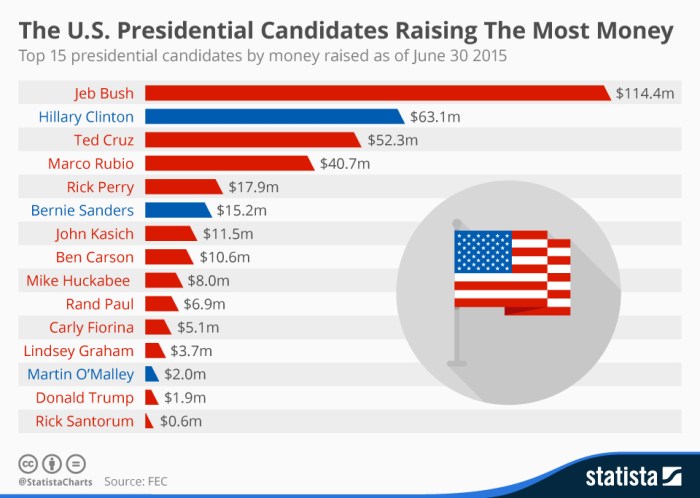
The net worth of presidential candidates can create a complex web of potential conflicts of interest, influencing governance in profound ways. As a nation’s leader, the president’s personal finances can intersect with public office, sparking concerns about impartial decision-making and favoritism.When a president’s personal wealth is vast, it can create a perception of undue influence from special interests, donors, or even family members.
This can lead to biased policies, as the president might prioritize initiatives that benefit their personal assets or relationships over those that benefit the greater good. For instance, a president with significant ties to the fossil fuel industry might be more inclined to support policies that benefit their business partners, rather than investing in renewable energy sources.
Campaign Finance and Influence
Campaign finance laws are designed to prevent the buying of elections by wealthy individuals or groups. However, when a president’s personal wealth is substantial, there’s a risk that they might use their campaign funds to benefit their own business interests or those of their close associates. This can create a self-serving dynamic, where the president prioritizes policies that enrich themselves rather than the public.As seen in [example: Donald Trump’s 2016 presidential campaign], the blurring of personal and campaign finances can lead to accusations of corruption.
Trump’s campaign accepted donations from Russian-linked entities, fueling speculation about the president’s relationship with foreign interests. This situation raises concerns about potential conflicts of interest and the influence of special interests on policy decisions.
Gifts, Favors, and Public Service
The president’s personal connections can also lead to conflicts of interest in the form of gifts, favors, or public service. For instance, a president with significant ties to a particular industry might be offered lucrative post-presidency consulting deals, creating a perception of quid pro quo. This can erode trust in the president’s ability to serve the public interest, as constituents wonder whether they’re making decisions for the greater good or for personal gain.In [example: the Clinton Foundation], philanthropic efforts can be seen as an attempt to create a positive image, while also serving as a conduit for personal influence.
The foundation’s ties to the State Department, where Hillary Clinton served as Secretary, raised questions about potential conflicts of interest in the awarding of government contracts or partnerships.
Transparency and Disclosure
To mitigate potential conflicts of interest, transparency and disclosure are essential. This includes publicly releasing personal financial information, as well as disclosing any ties to special interests or family members with business relationships. The president and their administration should also establish clear policies for separating personal and public interests, such as creating blind trusts for investments or divesting assets with potential conflicts.In [example: the Obama administration’s executive order on lobbying], the President’s team issued a directive requiring former administration officials to wait two years before lobbying on behalf of their previous employers or clients.
This move was seen as an attempt to prevent the revolving door between government and special interests.By acknowledging and addressing potential conflicts of interest, presidential candidates can work towards fostering a culture of transparency and accountability in governance. This not only strengthens public trust but also ensures that policies serve the greater good, rather than personal or special interests.
“The public interest should not be sacrificed on the altar of personal gain or special interests.”
Economic Growth Strategies Based on Presidential Candidate Net Worth

As the 2020 presidential candidates showcased their net worth, ranging from a net worth of zero dollars for some to billions of dollars for others, it becomes clear that financial priorities play a crucial role in shaping their economic growth strategies. This article will explore the design of economic growth strategies based on the net worth and financial priorities of the 2020 presidential candidates and discuss potential pros and cons of implementing such a strategy.
Top Earners: Trillion-Dollar Economy Plans
The presidential candidates with the highest net worth, such as Michael Bloomberg and Tom Steyer, proposed trillion-dollar economy plans to boost economic growth. Their strategies focus on massive infrastructure investments, tax cuts, and green energy initiatives to stimulate economic growth. The key aspects of their trillion-dollar economy plans include:
- The creation of millions of jobs in the infrastructure sector, which would not only boost economic growth but also improve the quality of life for Americans.
- Investments in renewable energy and green technology to reduce the country’s reliance on fossil fuels and create new industries.
- Tax cuts for middle-class families and small businesses to increase consumer spending and encourage entrepreneurship.
These plans are aimed at putting the country back on the path of sustained economic growth, but critics argue that they might increase the national debt and exacerbate income inequality.
Average Net Worth: Middle-Class Friendly Plans, 2020 presidential candidates net worth
Candidates with average net worth, such as Bernie Sanders and Elizabeth Warren, proposed economic growth strategies that focus on middle-class families and small businesses. Their plans aim to increase the economic security of the middle class by addressing issues such as student loan debt, affordable housing, and tax fairness. Key aspects of their plans include:
- The introduction of a wealth tax to reduce income inequality and generate revenue for social welfare programs.
- The expansion of access to affordable healthcare, education, and job training programs to enhance economic opportunities for middle-class families.
- The elimination of tax loopholes and deductions for large corporations to increase tax revenue and reduce the burden on middle-class families.
These plans prioritize the well-being of middle-class families and small businesses, but critics argue that they might discourage entrepreneurship and limit economic growth.
Net Worth of Zero: Progressive Plans
Presidential candidates with a net worth of zero, such as Tulsi Gabbard, proposed economic growth strategies that emphasize social and economic justice. Their plans focus on addressing issues such as climate change, income inequality, and access to affordable healthcare. Key aspects of their plans include:
- The implementation of a universal basic income to ensure a minimum standard of living for all Americans.
- The transition to a green economy by investing in renewable energy and reducing the country’s reliance on fossil fuels.
- The expansion of access to affordable healthcare, education, and job training programs to enhance economic opportunities for low-income families.
These plans prioritize the well-being of low-income families and the environment, but critics argue that they might be unrealistic and require significant investments from the government.
Net Worth Variability: A Mixed Bag
The 2020 presidential candidates with varying net worth levels showed a range of economic growth strategies. While some focused on trillion-dollar economy plans, others emphasized middle-class friendly plans or progressive plans. The key takeaway is that each candidate’s net worth and financial priorities influenced their economic growth strategies.In conclusion, the economic growth strategies proposed by the 2020 presidential candidates reflect their unique financial priorities and net worth levels.
By understanding these strategies, we can gain insight into the economic vision of each candidate and the potential impact of their policies on the US economy.
Relationship between Presidential Candidate Net Worth and Economic Policy Choices
Presidential candidates’ net worth can significantly influence their economic policy choices, shaping the country’s economic trajectory in meaningful ways. This complex dynamic is often shaped by individual values, experiences, and ideologies, ultimately translating into distinct policy orientations. In essence, a candidate’s net worth can affect their priorities when it comes to taxation, budget allocation, and overall economic decision-making.
Distribution of Economic Resources
The distribution of economic resources, including taxation and budget allocation, is a crucial aspect of economic policy decisions. Candidates with significant net worth often prioritize tax policies that benefit their own economic interests, such as reducing corporate taxes or exploiting tax loopholes. For instance, billionaires like Donald Trump and Michael Bloomberg have historically advocated for tax policies that benefit high-income earners, which can exacerbate wealth inequality.
Taxation Policy
Taxation policy is another critical area where presidential candidates’ net worth can shape their economic policy choices. Candidates with significant net worth often advocate for lower tax rates on wealthy individuals and corporations, which can lead to reduced government revenue and increased wealth concentration. Additionally, they may push for tax policies that benefit large corporations, such as special interest tax breaks or reduced capital gains taxes.Tax policies that favor the wealthy can have far-reaching consequences, including increased wealth inequality and reduced government revenue.
According to a study by the Tax Policy Center, the Tax Cuts and Jobs Act (TCJA), signed into law by President Trump in 2017, primarily benefited high-income earners and large corporations, exacerbating wealth inequality in the United States. The study found that the TCJA’s tax cuts for corporations resulted in significant windfalls for multinational corporations and large private equity firms.
The TCJA’s tax cuts for corporations were largely concentrated among the top 1% of earners, with the top 0.1% of earners receiving more than 40% of the total corporate tax cuts.
Government Spending and Budget Allocation
Government spending and budget allocation are other areas where presidential candidates’ net worth can shape their economic policy choices. Candidates with significant net worth often prioritize spending on initiatives that benefit their own economic interests, such as infrastructure projects that benefit their business ventures or investments. For instance, Donald Trump has been a vocal supporter of infrastructure spending, but his plan often prioritizes projects that benefit his own business interests, such as the Dakota Access pipeline.
Presidential candidates’ net worth can shape their economic policy choices in several ways, from taxation and budget allocation to government spending and infrastructure development. While these choices can have far-reaching consequences for the country’s economy, they are often driven by individual values, experiences, and ideologies rather than a broader national interest. By understanding these dynamics, Americans can better navigate the complex landscape of economic policy and advocate for reforms that promote a more equitable and sustainable economic trajectory.
Impact on the Economy
The economic policy choices influenced by presidential candidates’ net worth can have significant implications for the country’s economy. For instance, policies that favor the wealthy can lead to increased wealth inequality, reduced government revenue, and decreased economic mobility. Conversely, policies that benefit low- and middle-income earners can promote greater economic equality and a more sustainable economic trajectory.In order to mitigate the potential negative consequences of these policy choices, it is essential to promote greater transparency and accountability in the economic policy-making process.
This can involve measures such as:* Publicly disclosing presidential candidates’ net worth and potential conflicts of interest
- Establishing independent agencies to oversee government spending and budget allocation
- Implementing policies that promote economic equality and sustainability
- Encouraging civic engagement and participation in economic policy debates
By working together, Americans can create a more equitable and sustainable economic system that promotes the well-being of all citizens, rather than just the wealthiest few.
Ensuring Transparency and Accountability in Presidential Candidate Financial Disclosures

Transparency and accountability measures play a crucial role in fostering public trust in governance. Presidential candidate financial disclosures are a vital aspect of this process. By shedding light on a candidate’s financial dealings, the public can make informed decisions when casting their ballots. To mitigate potential conflicts of interest and promote accountability, it’s essential to implement robust transparency measures.
Recommendations for Implementing Transparency Measures
To ensure that transparency measures are effective, we propose the following best practices:
- Simplify Disclosure Forms: Streamline financial disclosure forms to make them more accessible and easier to understand for the general public. This can be achieved by breaking down complex information into clear, concise sections.
- Publicly Available Data: Ensure that financial disclosure data is easily accessible online, allowing voters to quickly analyze a candidate’s financial history and connections.
- Independent Oversight: Establish an independent review board to verify the accuracy of financial disclosures and identify potential discrepancies.
- Regular Audits: Conduct regular audits to ensure compliance with disclosure regulations and prevent tampering with financial data.
Importance of Independent Oversight
Implementing Effective Conflict of Interest Protections
To ensure that presidential candidates are held accountable for potential conflicts of interest, we recommend the following measures:
- Divestment Requirements: Mandate that presidential candidates divest from any financial interests that could influence their decision-making as President.
- Candidate Wealth Disclosure: Require presidential candidates to disclose their total wealth, along with a breakdown of their assets and liabilities.
- Gift and Benefit Declarations: Establish rules for declaring gifts, charitable donations, and other forms of financial support received by presidential candidates or their families.
Public Confidence in Governance
By implementing robust transparency and accountability measures, we can build public confidence in our governance system. When citizens have faith in the integrity of their leaders, they are more likely to participate in the democratic process and trust in the outcome of elections.Transparency and accountability are essential components of a healthy democracy. By following our proposed recommendations, we can create a system where presidential candidates are held accountable for their financial dealings, fostering a culture of trust and integrity in our government.
Addressing the Challenges Ahead
Implementing transparency and accountability measures in presidential candidate financial disclosures will not be without its challenges. We must address issues related to:
- Complexity and Clarity: Ensuring that financial disclosure forms are clear and concise while maintaining the required level of detail.
- Technological Advancements: Adapting to technological advancements to make financial data more accessible and user-friendly.
- Resources and Funding: Allocating sufficient resources and funding to support the implementation and enforcement of transparency measures.
By proactively addressing these challenges, we can create a robust system of transparency and accountability, ensuring that presidential candidates are held to the highest standards of integrity and honesty.
Empowering the Public
Transparency and accountability measures are only effective if the public is empowered to engage with financial disclosure data. We must educate citizens on how to analyze financial information, providing them with the tools and resources necessary to make informed decisions.
Fostering a Culture of Transparency
A culture of transparency is essential for building trust in governance. By consistently reinforcing transparency and accountability measures, we can create an environment where honesty and integrity are valued.
Holding Leaders Accountable
In conclusion, transparency and accountability measures are critical components of a healthy democracy. By implementing robust measures, we can ensure that presidential candidates are held accountable for their financial dealings, fostering a culture of trust and integrity in our government.
Visualizing the Net Worth Distribution among 2020 Presidential Candidates using Bullet Points

The 2020 presidential candidates varied significantly in terms of their net worth, ranging from several million to billions of dollars. This wealth disparity had a considerable impact on their policy decisions and interactions with the business world.To understand the distribution of net worth among major presidential candidates in the 2020 elections, we compiled a list of their net worth as estimated by reputable sources.
This visual representation of the data provides insight into the economic landscape of the candidates and can be compared to historical data for a more informed perspective.
Candidates with the Highest Net Worth
The top five candidates by net worth were:• Michael Bloomberg – estimated net worth of $60 billion• Donald Trump – estimated net worth of $3.1 billion• Mitt Romney – estimated net worth of $250 million• Bernie Sanders – estimated net worth of $2.5 million• Elizabeth Warren – estimated net worth of $14.5 millionThese candidates’ substantial wealth influenced their policy decisions and their connections to the business world.
For instance, Michael Bloomberg’s vast fortune enabled him to invest in various industries, including finance and technology. Meanwhile, Donald Trump’s net worth was partly fueled by his business empire, which included real estate, hospitality, and entertainment ventures.
Candidates with Lower Net Worth
On the other hand, some candidates had much lower net worths, largely due to their career choices, financial decisions, or other factors. For example:• Pete Buttigieg – estimated net worth of $50,000• Andrew Yang – estimated net worth of $10 million• Tulsi Gabbard – estimated net worth of $500,000These lower net worth candidates often focused on issues such as income inequality, taxation, and financial reform.
They argued that their more modest financial situations made them more relatable to ordinary Americans and better equipped to understand the struggles of the middle and lower classes.
Comparing to International Benchmarks
It’s also useful to examine the net worth distribution of the 2020 presidential candidates in the context of international benchmarks. According to a 2020 report by Oxfam, the wealthiest 2,000 people in the world hold as much wealth as the poorest 4.6 billion people. This staggering disparity highlights the global issue of economic inequality, which many of the lower net worth candidates addressed in their campaigns.By visualizing the net worth distribution among major 2020 presidential candidates, we can better understand the complex relationships between wealth, policy, and governance in the United States.
This data-driven approach enables us to make more informed comparisons with historical data and international benchmarks, shedding light on the broader implications of wealth disparities in the context of politics and public policy.
Clarifying Questions
Q: What is the significance of presidential candidate net worth in the election process?
A: The net worth of presidential candidates plays a crucial role in maintaining transparency and trust in governance, as it reflects their financial connections and potential conflicts of interest.
Q: Can presidential candidate net worth influence their economic policy choices?
A: Yes, the net worth of presidential candidates can significantly influence their economic policy choices, such as taxation and budget allocation, which can have substantial implications for the country’s economy.
Q: How do historical fluctuations in presidential candidate net worth correlate with national debt levels?
A: Historical research shows that fluctuations in presidential candidate net worth have correlated with national debt levels, suggesting that their financial situations can impact the country’s economic stability.
